Icon

Bullitt

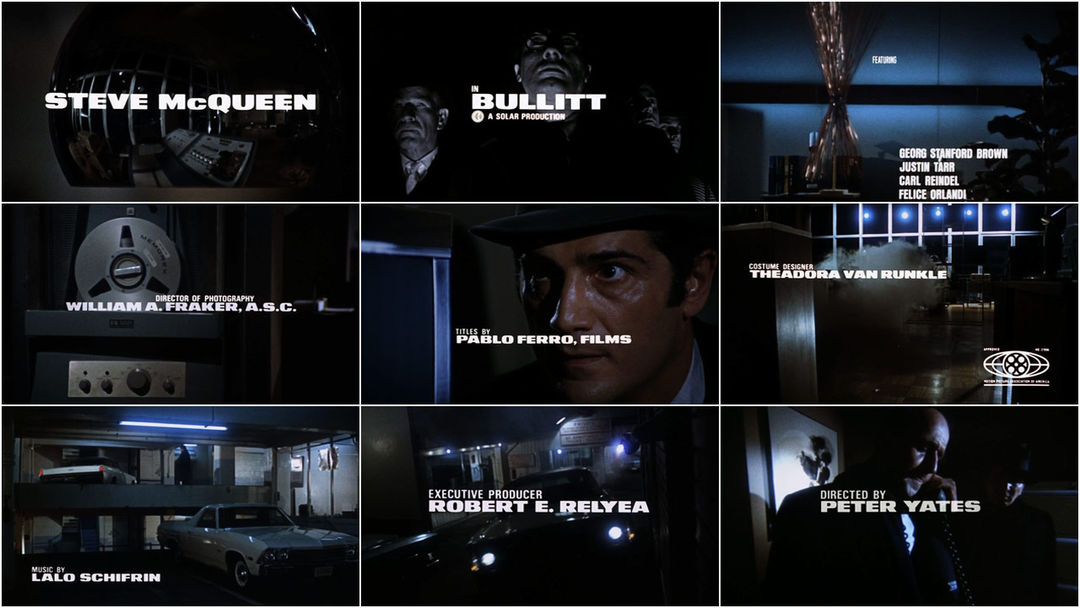
Bullitt contact sheet
Click to Watch SD
| Click to Watch HD | iPod/iPhone

USA | 1968 | Color | 1.85:1 | English

Credits

Title Design: Pablo Ferro, Films

Category: Film

Tagged: ,

4 Responses

  1. Wayne D says:

    A very disjointed title sequence for a rather disjointed and detached film.

    That said, Bullitt is my favorite movie. The thing I like about these title sequences, and the film as a whole for that matter, is that everything isn’t spelled out for the viewer — leaving room for interpretation and that unsettling feeling the day after watching it.

    IMHO, directors in general these days tend to fill in the gaps a little too much. Combined with the addiction to ‘do it cg/post’ this leads to little or no imagination on the part of the audience member.

    my 2¢.

    Wayne

  2. sandra g says:

    I think the sequence introduces the film really well – a bit of a teaser towards the end that gets the viewer involved. The sequence doesn’t seem disjointed at all – it depends on the viewer’s ability to follow a story I suppose………..I liked it!

  3. giorlando says:

    I also find the term disjointed peculiarly out of place. This title sequence beautifully sets the stage for two of the most intriguing cinematographic themes in this film, viz., fluidity and transparency/translucency. In virtually every frame of this film Yates’ camera is gently slipping away – or the camera is still and the actors are slipping off the frame. Even when the action gets cranked up the frame manages to incorporate a layer of gentle slippage to the motion.

    As for transparency, just count the number of times scenes are shot through – or significant details are seen through- transparent materials. In the title sequence Ferro has managed to take both of these visual devices to an even higher level by having the typography itself not only constantly slipping and irising but also having it create dynamic compositional seams. Although a great movie, this is another fine example of how the limits of title sequence can be turned into a strength and ultimately provide perhaps a more potent expression of the visual themes or style because of its concentrated succinctness and freer narrative structure.

    Some of these visual themes are evident in other work by Ferro and I think it would be an interesting study to see how much a primary director may have been influenced by title sequences.

  4. [...] Art of the Title Sequence is an awesome website that analyses and features some of the best Title Sequences from Cinema ever [...]

Leave a Comment

Interviews

ISO Design on A History of Scotland
Danny Yount on Sherlock Holmes
Gareth Edwards on How We Built Britain
Yellowshed on Cloudy with a Chance of Meatballs
Chic & Artistic on Dan Black's “Symphonies”
Nirvan Mullick on Willard
Sfaustina on Tetro
Kevin Dart, Stephane Coedel and Cyrille Marchesseau on A Kiss From Tokyo
Matteo Manzini on Chéri
Jim Capobianco and Alexander Woo on WALL·E
Edd Kargin on Novaya Zemlya
David Daniels on Freaked
Kyle Cooper on The Incredible Hulk
Garson Yu on Hulk
Zephyr on Wild Style
Howard Nourmand on The Dog Problem
Nina Paley on Sita Sings the Blues
Stephane Coedel on The Amazing Adventures of Kid Cole & Klay
Stefan Bucher on The Fall

Affiliate

Browse

Latest Updates via Twitter

Twitter Updates

    follow us on Twitter

    Master Index

    © 2009 The Art of the Title Sequence. All other names and trademarks appearing on ArtoftheTitle.com are the property of their respective owners. The written content on The Art of the Title Sequence is licensed under an Attribution-Noncommercial-No Derivative Works 3.0 Unported Creative Commons License