
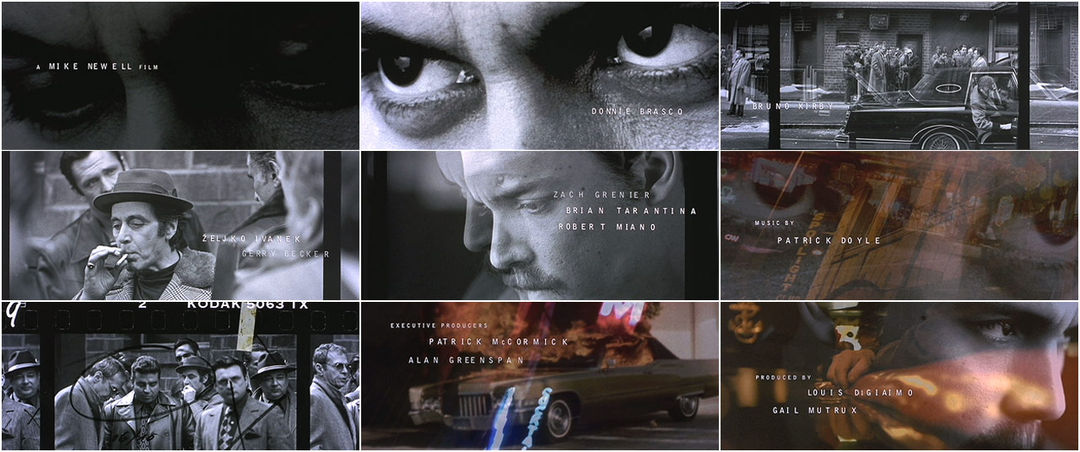


Author Andrea Codrington discusses the opening titles for Donnie Brasco, from her 2003 book Kyle Cooper: Monographics.
One of the first main titles to be done under the Imaginary Forces name, Donnie Brasco is a micro-narrative so moody and evocative that it had one New Yorker critic praising it above the film itself. Using a combination of predominantly black-and-white and colour stills shot in surveillance style — complete with Kodak markings and grease-pencil scribblings — Cooper choreographs an unsettling sequence about friendship, betrayal and the implosion of relationships caught in the middle. Accompanied by a delicate piece of music by Beethoven, the gritty still images become animated thanks to a carefully choreographed edit that favours slow fades punctuated by rapid-cut action sequences and the occasional piece of live footage. The titles begin and end with a view of Johnny Depp's dark-ringed eyes looking from outside — an impostor cop in the midst of New York wise guys.
Andrea Codrington is a Brooklyn-based editor and writer specializing in design and visual culture. She is the co-author of Pause: 59 Minutes of Motion Graphics and sole author of Kyle Cooper: Monographics and has written extensively for such publications as The New York Times, The Washington Post, Harper’s Bazaar, Elle, Metropolitan Home, Metropolis and Cabinet.
Designer/Director: Kyle Cooper
Designer/Editor: Kurt Mattila
Production Studio: Imaginary Forces
Discover more Kyle Cooper
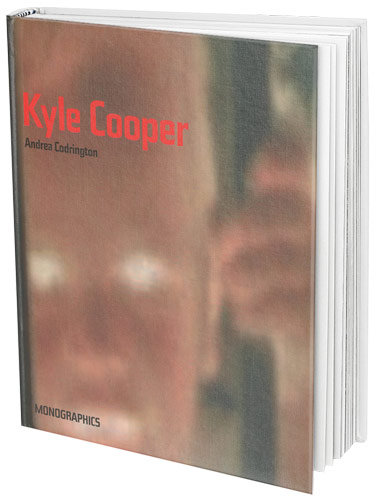
KYLE COOPER: MONOGRAPHICS
By Andrea Codrington
Related
-

Mission: Impossible
summary
-
The Negotiator
title only
-
Sphere
summary
-

Mimic
summary
-
Dreamcatcher
summary
-
Se7en
interview