The Art of the Title Sequence

Sita Sings the Blues (+ Nina Paley interview)

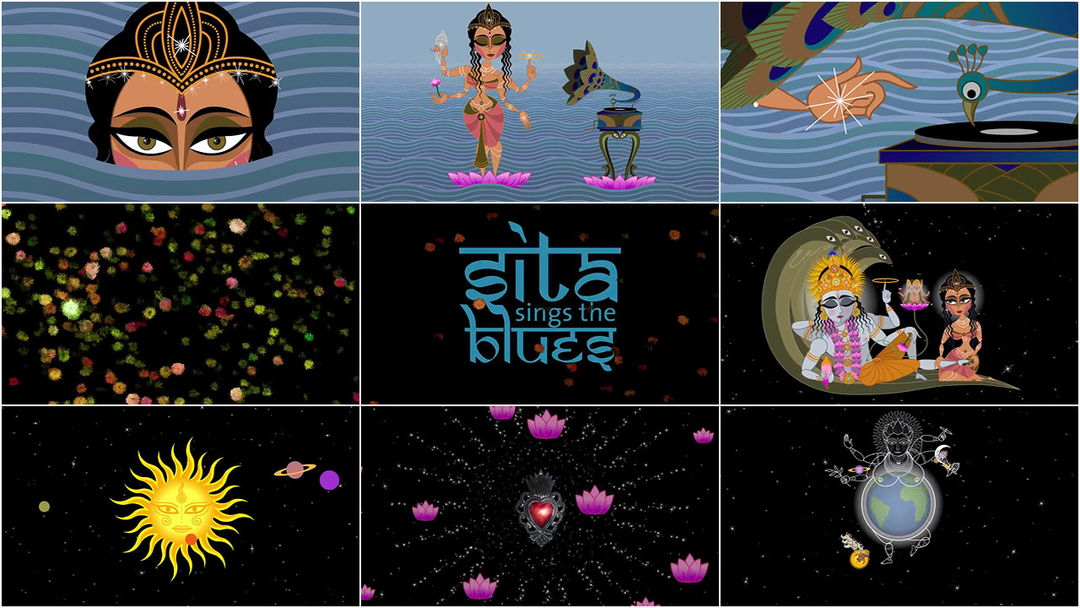
Sita Sings the Blues contact sheet
Click to Watch SD
| Click to Watch HD

“Don’t get set into one form, adapt it and build your own, and let it grow, be like water. Empty your mind, be formless, shapeless; like water. If you put water into a cup, it becomes the cup. You put water into a bottle it becomes the bottle. You put it in a teapot it becomes the teapot. Now, water can flow or it can crash. Be water my friend.” – Bruce Lee

The opening title sequence to Nina Paley’s “Sita Sings The Blues” features Indian goddess “Sita” with the curves of planets in her animated beauty.

The film deftly weaves the Indian Ramayana -with a respectful-but-no-less-sharp MST3K shadow puppet treatment, the heartbreaking failure of Paley’s own marriage, and the preordained 1920’s jazz of Annette Hanshaw -one of the first great female jazz singers who could swing. Each story breathes a kind of refracted understanding in divine continual proportion. It is impressive.

Once the sequence bursts into effulgent, fuzzy light showers to Todd Michaelsen’s sitar-and-synth-stabbing beat, we are introduced to characters of the Ramayana representing only one of the styles of animation found in the film. Too, the human heart, beating fierce at the center from which lilts Mother Earth.

Please note that this is a heavily awarded film, championed by Roger Ebert, that endures delayed distribution due to archaic copyright laws. A possibility that remains is online decentralized audience distribution. If you are interested in learning more please visit:

Sita Sings the Blues
Nina Paley’s blog
Question Copyright

USA | 2008 | Color | 1.85:1 | English

Direct Link: 480p (QuickTime, 848×480, 89 MB, 05:07) + 720p (QuickTime, 1280×720, 189 MB, 05:07)

Interview

A Q&A with creator Nina Paley.

Art of the Title: How did you develop the various artistic styles for the film? The differences are striking.

Nina Paley: I immersed myself in Ramayana art. There’s thousands of years of it from pretty much every country in South and Southeast Asia. I had no shortage of inspiration. The visual styles included in “Sita” are but a tiny sampling of what’s out there. As to how I chose…everything in the film felt like it chose itself. If anything seemed to work, I went with it; if something didn’t work, I threw it back.

ATS: Why did you feel that this story needed to be a feature film?

NP: I wanted to work through the story for personal reasons. It’s a big story; it called for feature length. Initially it was just a short, “Trial by Fire,” which was 3 minutes. Most audiences liked it but didn’t get the Ramayana references. I realized I’d have to expand the story for audiences to receive my message. My art isn’t finished until an audience “gets” it.

ATS: How did you finalize the structure?

NP: Intuitively.

ATS: With regards to in the incredible intricacy of the storytelling, how did you know what something was right; is it from the gut?

NP: From the gut, or maybe the heart. I like to think all my organs were cooperating on this, even my brain.

ATS: How did you discover Annette Hanshaw’s music?

NP: After my husband dumped me by e-mail I was staying with various friends-of-friends. One place belonged to a record collector, and some old Hanshaw sides were on his shelf. My friends played Hanshaw’s “Mean to Me” and I was hooked. Later one friend bought me an all-Hanshaw CD he found. I played that thing over and over during the months after my break-up.

ATS: What qualities does it possess for you to lead to its historic usage?

NP: The synchronicity of the Hanshaw songs and Sita’s story is uncanny. This impresses audiences and allows the film’s point to be made: the story of the Ramayana transcends time, place and culture. Because the songs feature an authentic voice from the 1920’s, they demonstrate that this story emerged organically in history. New songs composed by the director, while they could be entertaining, could not make that point. They would be a mere contrivance, whereas the authentic, historical songs give weight to the film’s thesis. They are in fact the basis of the film’s thesis, irrefutable evidence that certain stories – like the story of Sita and Rama – are inherent to human experience.

ATS: What element of the film is closest to your heart?

NP: I think my favorite scene is “Agni Pariksha,” that rotoscoped bit that comes shortly after the intermission. It doesn’t feel anything like the rest of the film – it’s not funny at all. It was my attempt to convey what my heartbreak felt like, emotionally. Although I only got a tiny little fraction of the experience in there, I think it works. In some ways it’s the heart of the movie.

ATS: How are you keeping the copyright issue from overshadowing the film itself? How will copyright inform your creativity on future projects?

NP: I am never again going to close-license (“copyright”) my own art. Any publisher or distributor that wants to work with me is going to have to accept an open license. Open content has been generating lots of money in software for years; it’s time for popular culture to follow.

ATS: What is next for you?

NP: Freeing “Sita”! I’m currently a full-time Free Culture activist. And I plan to make some short cartoons on this current obsession.

Extras

Video Extra iconSita Sings the Blues

Watch/download/burn the full-length animated film at Archive.org! The H.264 MPEG4 encodes are courtesy of Art of the Title.

Direct Link: 480p (MPEG4, 848×480, 1.3 GB, 01:21:50) + 720p (MPEG4, 1280×720, 2.4 GB, 01:21:50) + 1080p (MPEG4, 1920×1080, 4.1 GB, 01:21:50)

Video Extra iconSita Sings the Blues – Trailer

Sita Sings the Blues - Trailer contact sheet
Click to Watch SD
| Click to Watch HD

Direct Link: 480p (QuickTime, 848×480, 28 MB, 01:41) + 720p (QuickTime, 1280×720, 50 MB, 01:41)

Image Extra iconProductions Stills and Posters (36.7MB Zip Archive)

Sita Sings the Blues stills thumbnail strip

Credits

Title Designer: Nina Paley

Bookmark and Share

Category: Film, Interviews

Tagged: , ,

  • SITA SINGS THE BLUES DVD RELEASE AND LAUNCH PARTY IN NYC ON JULY 28

    FilmKaravan cordially invites you to celebrate the DVD Release of the critically acclaimed and festival-favorite film, SITA SINGS THE BLUES. View the invite - http://tinyurl.com/nmy3h7

    Rent now on Netflix or buy on Amazon.
    New York Times - http://tinyurl.com/nt9x39
    Trailer- http://tinyurl.com/79sv6n
    Queue it on Netflix - http://tinyurl.com/kuzhg4
    Pre-Book on Amazon - http://tinyurl.com/mp7t3j
  • Jordan is correct - that is Laxmi. Thanks Jordan, for the compliments also.

    And thanks Ian, who is making all the high quality compressions of "Sita" which are now the sources for all other copies. Heroic!
  • A correction: the opening titles do not feature Sītā but Lakshmī, whom Sītā is one of the human incarnations of, as far as modern, standardised Hinduism and Paley's film are concerned. Though Sītā is a form of Lakshmī, their character designs in the film are quite different.

    But let's not dwell on errata; the prologue sequence with Lakshmī and the firework-ish bursts of energy that followed (which looked to be re-used from or in the style of those in the Agni Pariksha sequence, if I remember correctly, though I found them more even impressive when shown "solo" here) were my favourite part of the film – a film which, I might add, truly comes into its own when seen on 35 mm film; the finishing touch of conversion to an analogue format combining with the choice of colours and ambient movement of the hair and water gives an extraordinarily velvety feel to this scene in particular.

    The Agni Pariksha and cartoon musical sequences retain their strength for being the emotional heart from which all else grew but the more external ones which were presumably done later felt more impressive and understandably more experienced and confident in terms of animation, even if they were actually less complex (with more complex characters but not so many moving about at once).
  • Art of the Title
    Art of the Title is handling the encoding, and you'll find a flac file at the following url: Sita_Sings_the_Blues_audio_only

    For some reason it hasn't shown up in the main listing yet, so the above is a direct link.

    We're also currently working on a couple of DVD versions, and I'm hoping to get those up by the end of this week.

    Ian
    -
    Editor, Art of the Title
  • Drakar
    Thanks so much for posting the different versions on archive.org - i'm assuming it was you guys, since nina credits you in her blog entries. The 1080p encoding is truly flawless - not an artifact or a lag to be found.
    I was wondering if you would post a lossless version of the movie's audio track? A wav is only about a gig and a flac would be maybe half that - I'm interested in making ac3 for dvd / avchd encodings, and/or a high-quality ogg for use in a .mkv container - but i wouldn't feel right transcoding it from the current aac...
    thanks!
    -Drakar
  • Muiz
    i LOVE this sequence - the shapes seem to fit perfectly and the music (the score is always so important as we know) is just spot on again - I love the heart beat sequence in the trailer.

    Though a friendly suggestion - perhaps reconsider the typeface for the title of the site? :)

    Otherwise - Im loving your work!
  • Jim
    I'm glad you guys did a post on this one. I just read about it in "Filmmaker" magazine; the whole fair-use debacle Paley has had to endure is really ridiculous!

    Of additional relevance to your site (which I really dig, btw): did you know that an Oscar for "Best Title Design" was proposed & rejected a decade ago? I find it disappointing -- but not surprising -- that it was not only rejected, but was only proposed such a short while ago.

    "Pink Panther" and "Dr. Strangelove" totally would've gone head-to-head for that award in '64!!
  • Good work on both this excellent article and the new site design! Enjoying it...
blog comments powered by Disqus

Interviews

Gareth Smith on Up in the Air
Krystian Morgan on The Thing³
Johnny Kelly on Het Klokhuis
ISO Design on A History of Scotland
Danny Yount on Sherlock Holmes
Gareth Edwards on How We Built Britain
Yellowshed on Cloudy with a Chance of Meatballs
Chic & Artistic on Dan Black's “Symphonies”
Nirvan Mullick on Willard
Sfaustina on Tetro
Kevin Dart, Stephane Coedel and Cyrille Marchesseau on A Kiss From Tokyo
Matteo Manzini on Chéri
Jim Capobianco and Alexander Woo on WALL·E
Edd Kargin on Novaya Zemlya
David Daniels on Freaked
Kyle Cooper on The Incredible Hulk
Garson Yu on Hulk
Zephyr on Wild Style
Howard Nourmand on The Dog Problem
Nina Paley on Sita Sings the Blues
Stephane Coedel on The Amazing Adventures of Kid Cole & Klay
Stefan Bucher on The Fall

Advertising

Browse

Latest Updates via Twitter

Twitter Updates

    follow us on Twitter

    Master Index

    © 2010 The Art of the Title Sequence. All other names and trademarks appearing on ArtoftheTitle.com are the property of their respective owners.